Sirius — The Star Known Across Civilizations
A star many peoples honoured; the Qur'an names its Lord.
How to read this section
- Qur'anWhat the verse actually says.
- TafsirHow reliable Islamic scholarship explains the passage.
- ScienceWhat established scientific evidence currently demonstrates.
- ReflectionA thoughtful observation — not Tafsir, and not scientific proof.
What the verse says
A single clause, in a passage listing what God alone does and owns.
وَأَنَّهُۥ هُوَ رَبُّ ٱلشِّعْرَىٰ
And that it is He who is the Lord of Sirius.
Why this was significant when it was revealed
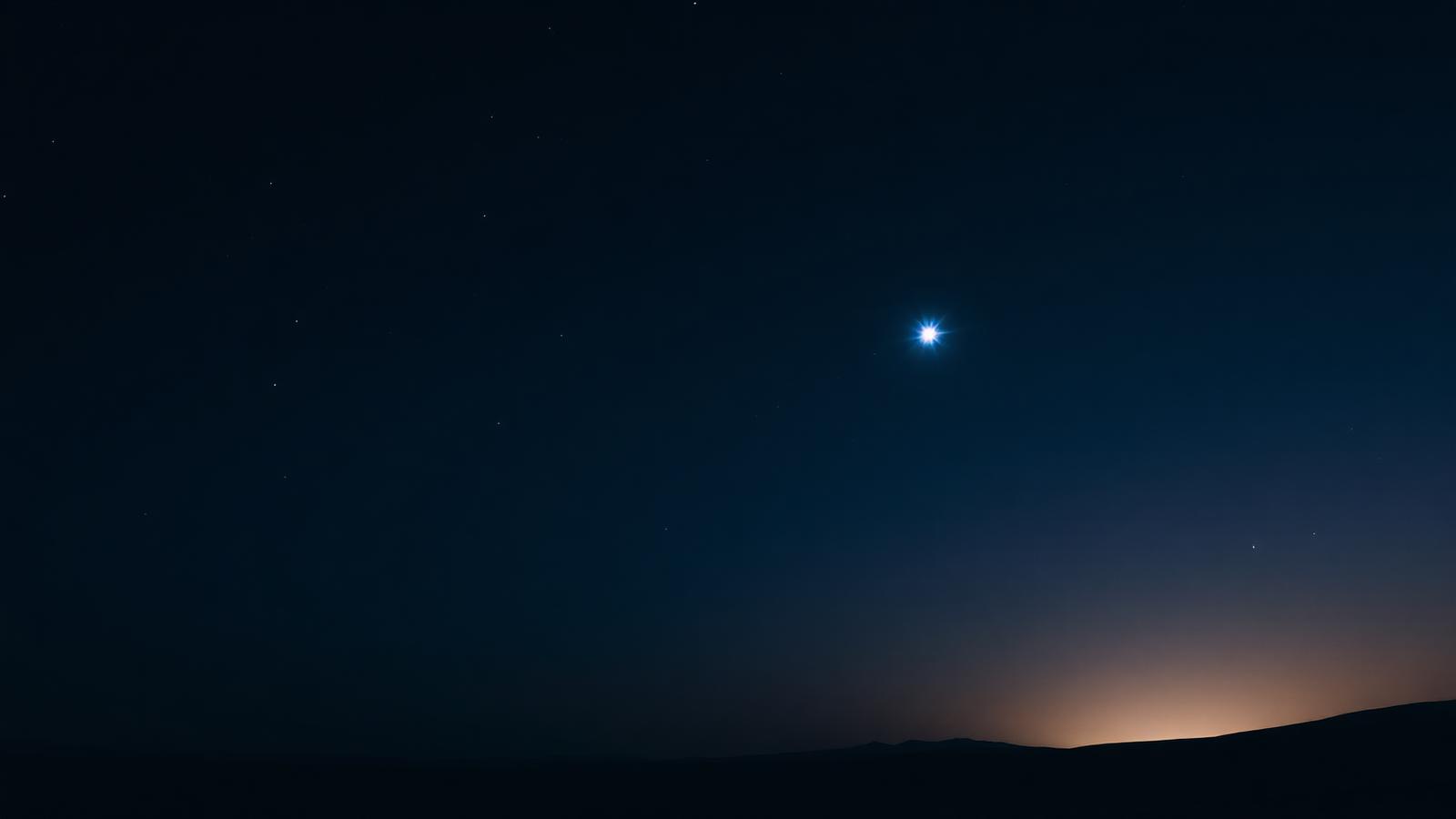
Al-Shi'rā is the Arabic name for the star known in English as Sirius. Commentators including al-Qurṭubī and Ibn Kathīr record that a group among the pre-Islamic Arabs venerated it.
The verse does not describe the star. It reassigns it. The brightest object in the night sky — an object some people honoured — is placed on the created side of the line, and its Lord is named. This is the theological point, and it is the only point the verse makes.
al-Qurṭubī, al-Jāmi' li-aḥkām al-Qur'ān, commentary on Q 53:49 · Ibn Kathīr, Tafsīr al-Qur'ān al-'Aẓīm, commentary on Q 53:49
What Sirius is
Sirius is the brightest star in Earth's night sky, about 8.6 light-years away — one of our nearest stellar neighbours. It is a binary system: Sirius A, a hot main-sequence star, and Sirius B, a faint white dwarf, the collapsed remnant of a star that exhausted its fuel.
Sirius B was inferred from the wobble of Sirius A in the 1840s and observed in 1862. Its heliacal rising was tracked by several ancient civilisations, including in Egypt, where it was tied to the calendar and the Nile flood.
NASA — Sirius A and B (Chandra X-ray Observatory / HubbleSite imagery and factsheets) · ESA Hipparcos catalogue — parallax distance to Sirius (~8.6 light-years)
A note on what we will not claim
Claims that Q 53:49 encodes the binary nature of Sirius, or its orbital period, are not supported by the Arabic or by recognised Tafsir. We do not publish them.
The reflection the verse invites is simpler and older than astronomy: across many civilisations, human beings looked at the most striking object in the sky and gave it a share of reverence. This verse cuts through all of that with four words.
Reflect on the sign
If even the brightest thing in the sky is a created object, what is worth worship?
Sources & References
4 cited- 1al-Qurṭubī, al-Jāmi' li-aḥkām al-Qur'ān, commentary on Q 53:49Records that a group of the Arabs venerated al-Shi'rā before Islam.
- 2Ibn Kathīr, Tafsīr al-Qur'ān al-'Aẓīm, commentary on Q 53:49
- 1NASA — Sirius A and B (Chandra X-ray Observatory / HubbleSite imagery and factsheets)Sirius A is the brightest star in Earth's night sky; Sirius B is a white dwarf companion.
- 2ESA Hipparcos catalogue — parallax distance to Sirius (~8.6 light-years)
Scientific sources establish empirical claims only. They are never used as evidence for theology, and no verse is re-read to fit a theory.